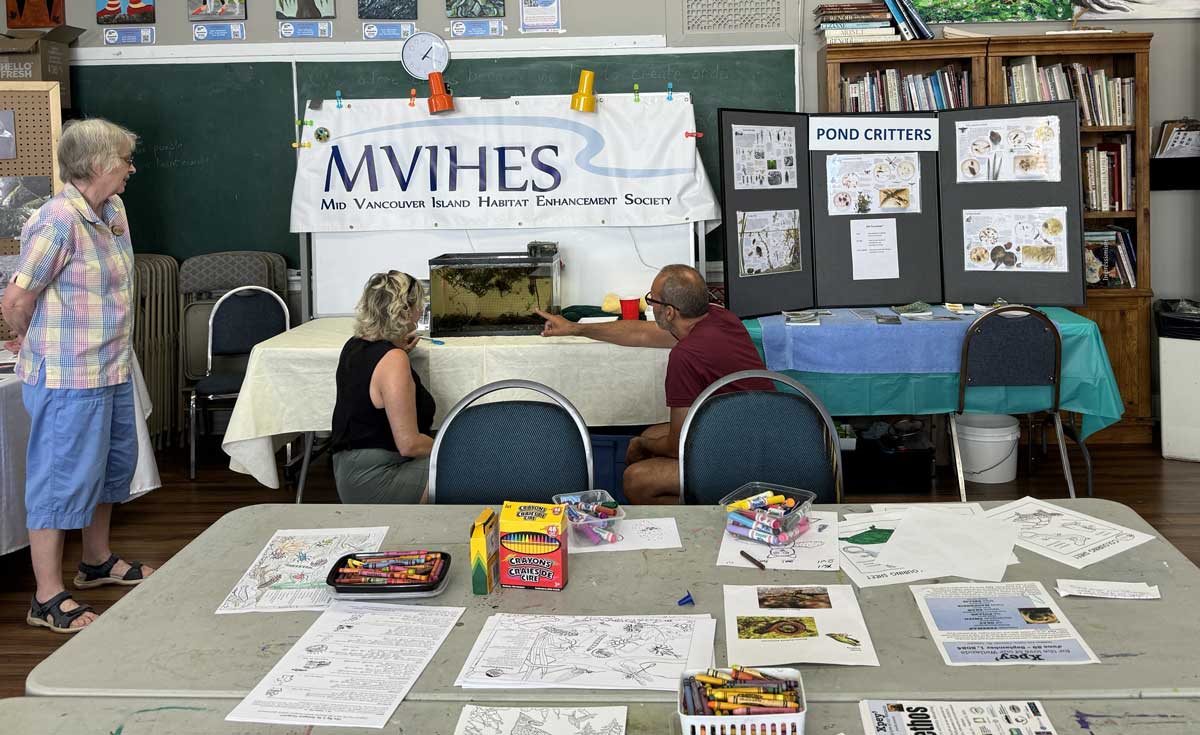
Running alongside the art exhibit was ETHOS, another interactive display at the MAC. Community groups and NGOs, including MVIHES, set up stations to show how we’re protecting our wetlands and why everyone should care. Our contribution was a Pond Critters Tank, where visitors could observe typical insects and invertebrates found in local marshes, ponds, and wetlands. From predation to mating to the occasional cannibalism, there was plenty of drama happening in that tank! It was a huge hit with curious onlookers, especially kids who loved getting up close to water bugs.
Many dedicated folks kept the Pond Critters Tank lively. Sue Wilson (Friends of Shelly Creek Park) oversaw the display alongside other MVIHES and Arrowsmith Naturalists volunteers. Special thanks go out to Terry Bajenko, Sally Soanes, Jeannie Diewold, Janet McManus, Catherine Watson, Larysa Bilous, Chris Smith, Jane Murray-Smith, Shelley Goertzen, Pete Law, Barb Riordan, Ross Peterson, and our Team Leader Maggie Estok, who set up the display with her son Ralegh. They made sure we had a constant supply of aquatic critters, assisted by Meghan MacIsaac (North Island Wildlife Recovery Centre), Jeannie Diewold (Arrowsmith Naturalists), Carl Rathburn, Pete Law, Craig Wightman, and Denis Cote.
We also took our traveling Pond Critters Tank to Beach Day in Qualicum Beach on July 21, where families and beachgoers learned about the importance of aquatic insects. Volunteers Kathy Miller, Liz Campbell, and Barb Riordan staffed the display and answered questions. Watching community members spark an interest in the hidden world beneath our waters was a fantastic reward for everyone involved.
Meanwhile, another group of volunteers continued our marine debris survey at Rathtrevor Beach on July 16. Under the guidance of Jacob Frankel from the Mount Arrowsmith Biosphere Region Research Institute, we surveyed a 100-meter stretch of beach for plastic debris—both macro (larger than 20 mm) and micro (under 20 mm). We’re thrilled to report that we found only a handful of macroplastics and no microplastics. This data goes into the National Oceanic and Atmospheric Administration (NOAA) database, helping researchers track global marine pollution. Huge thanks to our volunteers Yana Maltais, Martin Yeo, Liz Campbell, Bob Williams, and Barb Riordan for helping keep our shorelines pristine.