


Low-Tech Approaches for Salmon Habitat Restoration
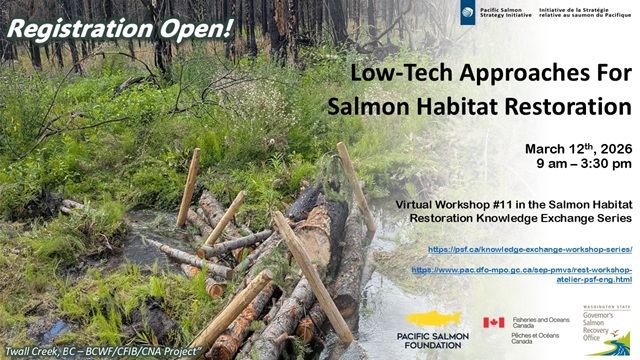
Low-Tech Approaches for Salmon Habitat Restoration: This virtual workshop brings together experts to discuss the latest practices and emerging techniques in low‑tech restoration. Presenters will share their expertise and lessons learned from implementing projects at a range of scales and offer guidance on where low‑tech approaches are most effective. Participants will gain practical insights and expert guidance to help advance the use of low‑tech methods in watershed stewardship and salmon recovery.
Low‑tech restoration approaches are rapidly gaining popularity as practitioners and funders seek affordable, scalable ways to restore natural processes, address stream impairments, and reintroduce structure and habitat complexity in watersheds. Over the past several decades of implementing these projects, we have monitored their effectiveness, refined our techniques, and created a space for innovation to achieve maximum benefit for minimum cost. In many settings, low‑tech approaches offer a cost‑effective and ecologically grounded way to achieve salmon recovery outcomes.
This virtual workshop, co‑hosted by Fisheries and Oceans Canada, Pacific Salmon Foundation, and Washington’s Governor Salmon Recovery Office, brings together experts to discuss the latest practices and emerging techniques in low‑tech restoration. Presenters will share their expertise and lessons learned from implementing projects at a range of scales and offer guidance on where low‑tech approaches are most effective. Participants will gain practical insights and expert guidance to help advance the use of low‑tech methods in watershed stewardship and salmon recovery.
-
- Beaver Dam Analogues (BDAs): Engineered to mimic the structure and function of natural beaver dams. They involve driving untreated wooden posts into the stream bed and weaving branches to create a barrier that encourages water pooling, which helps restore streams, particularly in damaged (“Stage 0”) conditions.
- Post-Assisted Log Structures (PALS): Similar to BDAs, these are designed to act like natural log jams. They use posts to anchor wood, which redirects flow, creates diverse habitat for fish, and improves floodplain connectivity.
- Low-Tech Approaches for Salmon Habitat Restoration: This virtual workshop brings together experts to discuss the latest practices and emerging techniques in low‑tech restoration. Presenters will share their expertise and lessons learned from implementing projects at a range of scales and offer guidance on where low‑tech approaches are most effective. Participants will gain practical insights and expert guidance to help advance the use of low‑tech methods in watershed stewardship and salmon recovery.